
A group home checklist Las Vegas families can actually trust should cover four things every single time: the living spaces, the caregiving staff, the licensing paperwork, and your own gut reaction the moment you walk in. Websites and brochures can only tell you so much — a well-designed page can make almost any facility look warm and welcoming. The real answers show up in person, in the details a photo never captures.
This guide walks you through exactly what to prepare, observe, and ask when you tour group homes in Las Vegas, so you leave each visit with a clear, honest picture instead of a polished sales pitch.
Why an In-Person Tour Matters More Than a Website
A website is written to persuade. A tour is where you actually verify.
When you walk through a home in person, you notice things no landing page or even a written checklist for your Las Vegas group home search will fully capture: how staff speaks to residents when they think no one’s watching, whether the home smells clean, and whether residents look engaged or simply parked in front of a television.
Treat the tour as your primary research tool. Everything else — reviews, phone calls, website copy — is secondary.
Before You Visit: Group Home Checklist Las Vegas Questions to Prepare
Walking in with a written list keeps the visit focused and makes it easier to compare homes afterward this is exactly what a group home checklist Las Vegas families use should do. Prepare answers to these before you go:
- What is your loved one’s daily routine and care needs (mobility, medication, memory support)?
- What is your monthly budget, and what’s included versus billed separately?
- Do you need a private or shared room?
- How soon does your loved one need to move in?
- What questions matter most to your family specifically (diet, faith practices, pets, visiting hours)?
Bring this list with you, along with a notebook. You’ll likely tour more than one home, and details blur together fast once you’ve seen two or three in the same week.
What to Observe in the Living Spaces
Once you’re inside, slow down and actually look — don’t just follow the guided path.
Cleanliness and upkeep. Check for odors, stained carpets, or cluttered hallways. A clean home doesn’t need to be spotless or sterile, but it should feel cared for.
Room setup. Ask to see an actual resident room, not just a model room. Is there natural light? Personal items like photos or a favorite chair? Enough space to move safely with a walker or wheelchair?
Safety features. Look for grab bars in bathrooms, non-slip flooring, clear walking paths, and visible emergency call buttons. In a home offering 24/7 senior care, these details should be built into the environment, not an afterthought.
Common areas. Are residents gathered and engaged, or isolated in their rooms? A lived-in living room with activity says more than any brochure photo.
What to Ask the Caregiving Staff
The staff you meet on tour day are the people who will actually care for your loved one so on any group home checklist Las Vegas families use, this is where most of your questions should go.
- What is your staff-to-resident ratio during the day, evening, and overnight?
- What training do caregivers complete before working independently?
- How do you handle a medical emergency, and how quickly can help arrive?
- How are medications tracked and administered?
- How often does a family receive updates, and who do we contact with questions?
- What happens if a resident’s care needs change over time?
Pay attention to how staff answers, not just what they say. Do they know residents by name? Do they speak with warmth or recite scripted lines? Watch a caregiver interact with a resident during your visit — that single moment often tells you more than a ten-minute interview.
Red Flags to Watch For
Most families know what a good home looks like. Fewer know what a warning sign looks like this is the exact gap a proper group home checklist Las Vegas families use is meant to close.
Be cautious if you notice:
- Reluctance to let you see certain rooms or meet residents directly. A home with nothing to hide will show you around freely.
- Visible short-staffing — call lights unanswered, residents waiting a long time for basic help, or staff who seem rushed and stressed.
- Unclear or evasive answers about licensing, staff turnover, or costs.
- Residents who appear unkempt, isolated, or medicated into inactivity rather than engaged.
- No documented emergency or care plan available for review.
- Pressure to sign quickly, especially without giving you time to think or compare other homes.
According to the National Institute on Aging, families should trust their instincts and raise any concern immediately rather than assume it will resolve on its own the same principle applies whether you’re touring a nursing home or a smaller residential group home.
Questions About Licensing and Inspections
Every legitimate group home in Las Vegas must be licensed through the Nevada Division of Public and Behavioral Health (DPBH), Bureau of Health Care Quality and Compliance (HCQC), which oversees residential facilities for groups across the state. Don’t be shy about asking to see this documentation directly.
Ask:
- Can I see your current state license?
- When was your last state inspection, and were there any citations?
- Are staff background checks required for everyone with resident access?
A licensed home should be able to answer these questions without hesitation. Life1 Care Home, for example, operates under Nevada License #11256-AGC-1 — details like this should always be something a facility shares openly, not something families have to dig for.
If you want to go deeper on how Nevada licenses and inspects these homes, that’s a topic worth its own read we’ll cover it fully in an upcoming guide dedicated to licensing and inspection standards.
Common Mistakes Families Make on a Tour
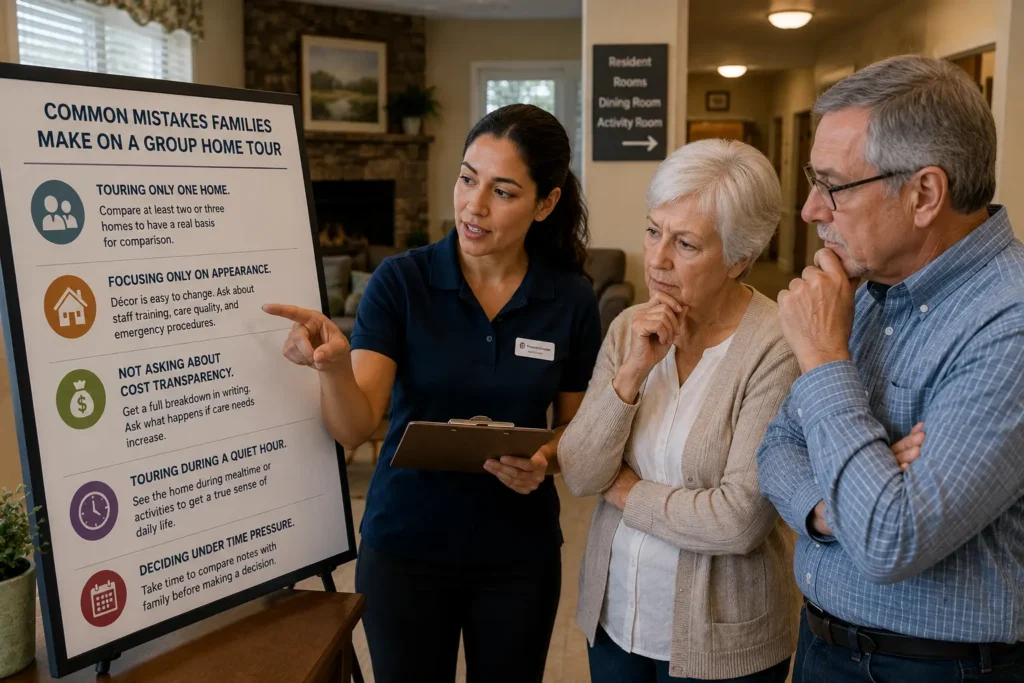
Even families touring with a full group home checklist Las Vegas experts recommend still fall into a few predictable traps. Watch for these:
Touring only one home. It’s tempting to stop looking once a place feels “good enough,” especially when the search feels emotionally heavy. Comparing at least two or three homes gives you a real basis for comparison instead of a single impression.
Focusing only on appearance. A freshly painted lobby says nothing about staff training or how emergencies are handled. Décor is the easiest thing for any facility to get right — it’s not where the real answers live.
Not asking about cost transparency. Get a full breakdown in writing before you commit. Ask specifically what happens if care needs increase — some homes charge more for additional support, and you want that spelled out ahead of time, not discovered later.
Touring during a quiet hour. If possible, ask to see the home during a mealtime or activity period, not just during a slow midday lull. This gives you a much more accurate sense of daily life.
Deciding under time pressure. A home that’s the right fit today will still be the right fit next week. Give yourself room to compare notes with family before signing anything.
Group Home Checklist Las Vegas Families Can Print
Bring this section with you on every tour:
- Rooms clean, personalized, and appropriately sized
- Safety features present (grab bars, call buttons, clear paths)
- Common areas active and welcoming
- Staff-to-resident ratio clearly stated
- Staff training and emergency response explained
- Current state license shown on request
- No pressure to sign immediately
- Residents appear engaged, clean, and comfortable
- Family communication process explained
Frequently Asked Questions
How long should a group home tour take?
Plan for 45–60 minutes. Rushed tours rarely give you enough time to observe staff-resident interactions or ask follow-up questions.
Should I visit unannounced?
A scheduled tour is standard and lets you meet the right staff, but a second, informal visit later can offer a more candid look.
What’s a normal staff-to-resident ratio for a small group home?
It varies by home and shift, so ask directly rather than assuming, smaller residential homes generally offer closer supervision than large facilities.
Can I bring my loved one on the tour?
Yes, and it’s recommended. Their comfort with the space and the caregivers matters as much as your own assessment.
What documents should I ask to see?
The current state license, most recent inspection results, and a sample care plan or agreement.
Is it normal for a home to ask about my loved one’s care needs before the tour?
Yes, this helps them show you accurately whether they can meet those specific needs.
What if I notice a red flag but everything else seems fine?
Trust it. One unresolved red flag is reason enough to keep looking or ask direct follow-up questions before moving forward.
How many homes should I tour before deciding?
Most families feel confident after visiting two to three homes. This gives you enough comparison points without dragging the search out for weeks.
What’s the difference between a group home and a larger assisted living facility?
A group home is typically a small residential setting with far fewer residents per caregiver, while assisted living communities operate at a larger, more institutional scale. Families touring both often notice the difference in personal attention immediately.
Ready to Tour a Home in Person? We’re Here to Help
Working through this checklist is a great first step but nothing replaces seeing a home for yourself. Our team is happy to walk you through every question on this list, show you around, and help you decide whether Life1 Care Home is the right fit for your loved one.
Get in Touch
📍 Location: 4075 Alto Avenue, Las Vegas, Nevada 89115
📞 Phone: 248-636-6220
📧 Email: life1carehome@gmail.com