

Eating well quietly gets harder as people age, and most families don’t notice the slide until weight loss or a hospital visit forces the issue. If you’re an adult child or caregiver who suspects an aging parent isn’t eating properly, it helps to understand why nutrition slips at home—and what real senior meal support in Las Vegas looks like once meals become part of daily, supervised care instead of something a senior has to manage alone.
At Life1 Care Home, fresh, balanced meals are prepared on-site every day as a built-in part of residential care — not a separate service a family has to arrange. This guide walks through why nutrition needs change with age, the warning signs families miss, and what daily senior meal support actually looks like inside a licensed Las Vegas group home.
Table of Contents
Why Senior Nutrition Needs Change With Age
Nutritional needs shift significantly after 65, even when appetite and activity level look the same on paper. Metabolism slows, but the need for protein, calcium, and certain vitamins (B12 and D) actually increases to protect muscle mass and bone density.
A few physical realities complicate this:
- Appetite naturally declines with age due to slower digestion and a reduced sense of smell and taste, which makes food less appealing even when someone knows they should eat.
- Chewing and swallowing difficulties (dysphagia, ill-fitting dentures) push seniors toward soft, low-nutrient “safe” foods like toast or crackers instead of balanced meals.
- Medication interactions are an overlooked factor — common prescriptions for blood pressure, depression, or acid reflux can suppress appetite or alter how food tastes.
The piece most families miss: “not hungry” often isn’t about needing less food—it’s a signal that something in the eating routine, or the medication regimen, needs a closer look. Our medication management guide for Las Vegas seniors covers how appetite-related side effects typically get missed, and our Health & Medical Support page covers how that monitoring fits into daily care.
Noticing appetite changes in a parent? Call 248-636-6220 for an honest read on what’s causing it — no pressure, just a conversation.
Common Challenges Seniors Face With Eating at Home
Most gaps in senior nutrition trace back to logistics, not willpower. It’s rare that someone “doesn’t want” to eat well—it’s that the steps required to get there have quietly become too hard.
Cooking alone becomes unsafe. Forgetting a stove burner on, difficulty standing for long periods, or reduced grip strength for handling pots and knives all discourage regular cooking—a risk we cover in more depth in our senior home safety guide for Las Vegas.
Memory lapses affect meals directly. A senior may genuinely forget whether they’ve eaten, skip meals entirely, or eat the same convenience snack repeatedly because deciding what to cook feels overwhelming. Our guide on dementia care in Las Vegas covers how memory-related changes tend to show up first at mealtimes.
Grocery access shrinks. Giving up driving cuts off spontaneous grocery trips, and many seniors quietly ration food between infrequent store runs.
Not sure whether the issue is nutrition alone or a broader safety concern? Our Personal Care Service covers daily support beyond meals, including hygiene, mobility, and daily routine assistance. And if cost is part of what’s holding a family back from full-time senior meal support, our group home cost breakdown for Las Vegas lays out what’s typically included.
This is exactly where dedicated senior meal support in Las Vegas makes the biggest difference—not by replacing independence, but by removing the specific friction point (shopping, prep, or safety) that’s causing meals to slip. It’s also worth looking at senior care services in Las Vegas more broadly, since nutrition rarely slips in isolation from other daily needs.
Meal Delivery vs. Senior Meal Support in a Group Home
Families sometimes look at meal delivery services first, since it feels like the smallest possible step. It’s worth understanding where that option helps—and where it falls short—before deciding what kind of senior meal support your parent actually needs.
| Factor | Meal Delivery (e.g., Meals on Wheels) | Daily Meals at Life1 Care Home |
|---|---|---|
| Who it’s for | Seniors still living independently | Residents in full-time group home care |
| Meal freshness | Often frozen or pre-packaged, reheated | Freshly prepared on-site, same day |
| Dietary adjustment | Limited, standard menu options | Adjusted as part of each resident’s care |
| Social element | Minimal—meals eaten alone | Shared dining with other residents |
| Oversight of intake | None—no one confirms the meal was eaten | Built into daily supervised care |
Meal delivery programs like Meals on Wheels can be a reasonable bridge for seniors who are otherwise independent and just need help with cooking logistics—Nevada’s Aging and Disability Services Division coordinates income-qualified senior meal delivery in Las Vegas and across Clark County for families who want to look into that option separately.
But delivery has a blind spot: no one confirms the meal was actually eaten, and there’s no adjustment if appetite changes week to week. That’s the gap daily, supervised meals are designed to close.
Weighing delivery against full daily care? Talk to our team at 248-636-6220 — we’ll help you figure out which one actually fits.
How Life1 Care Home Delivers Senior Meal Support in Las Vegas
Meals at Life1 Care Home are part of everyday residential care, not an add-on. Our Nutrition and Dining Services are built around balanced, fresh-prepared meals and dietary support to make mealtimes both nourishing and genuinely enjoyable—every day.
In practice, that structure looks like:
- Meals planned and prepared fresh on-site, not delivered or batch-frozen.
- Shared dining as part of daily social and emotional well-being — mealtime isolation is a quiet contributor to appetite loss, and shared meals naturally counter it.
- Nutrition support woven into each resident’s broader care plan, alongside personal care, medication support, and daily supervision.
Because meals are part of full-time residential care rather than a separate delivery service, a skipped meal or sudden change in appetite is something caregivers can notice and respond to the same day — not something a family has to catch from a distance. This same round-the-clock attention is part of why families also look at our 24/7 senior care in Las Vegas page when comparing options. If you’re weighing this level of senior meal support against a shorter tour-and-decide process, our group home checklist for Las Vegas families is a useful next step.
Warning Signs of Poor Nutrition in Seniors
Unexplained weight loss, persistent fatigue, and increased confusion are the three clearest red flags that a senior isn’t getting adequate nutrition — and each one tends to show up before a family realizes there’s a food-related cause.
Watch for:
- Weight loss of more than 5% of body weight within six to twelve months, even without a diet change.
- Fatigue or low energy that doesn’t improve with rest, often mistaken for “just getting older.”
- New or worsening confusion, which can stem from dehydration or vitamin deficiencies rather than cognitive decline alone.
- Loose clothing or dentures that suddenly fit poorly — a subtle but reliable physical cue.
If two or more of these show up together, it’s worth treating nutrition as the starting point for investigation, not an afterthought after a doctor’s visit.
Seeing two or more of these signs? Call 248-636-6220 — early attention makes this far easier to fix.
What Good Senior Meal Planning Looks Like
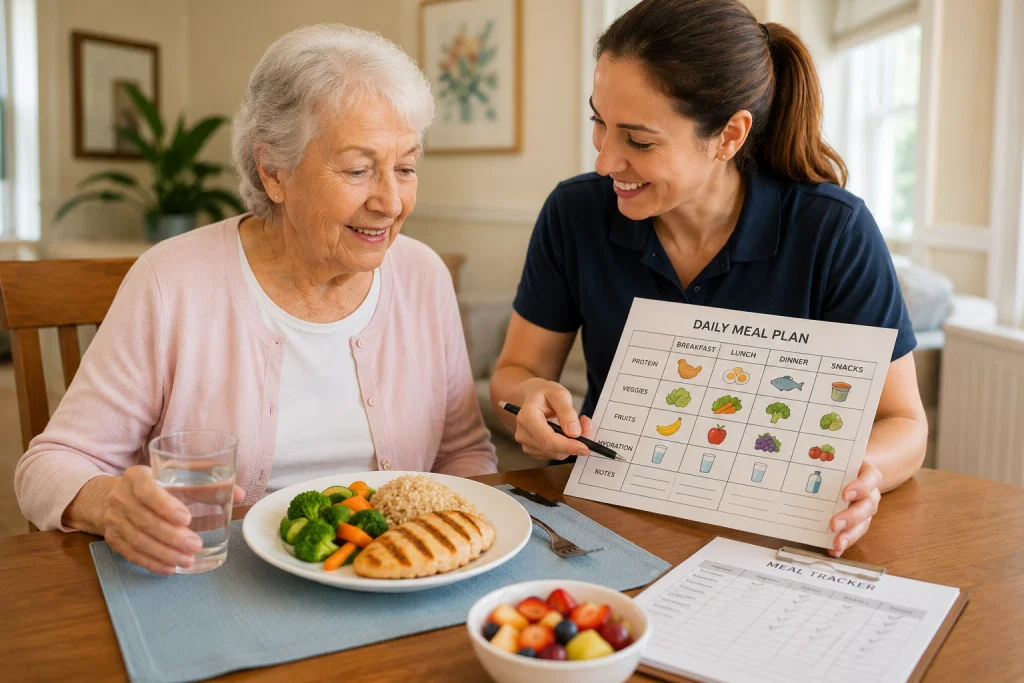
Effective daily meal planning for seniors balances three things at once: nutritional completeness, dietary restrictions, and consistent hydration—and most home routines only manage one or two of these reliably.
A well-structured senior meal plan typically includes:
- Protein at every meal, not just dinner, to help preserve muscle mass.
- Restriction-aware substitutions for diabetes, kidney disease, or heart conditions.
- Built-in hydration prompts, since thirst signals weaken with age.
- Texture-modified options for anyone with swallowing difficulty, without sacrificing nutritional density.
A “balanced” meal plan on paper can still fail in practice if no one tracks whether the senior actually finishes their plate. That day-to-day tracking is exactly what’s built into daily group home care, and it’s a core part of genuine senior nutrition care rather than a delivery menu alone.
Serving Families Across Las Vegas
Life1 Care Home supports residents and families throughout Las Vegas, North Las Vegas, Henderson, Paradise, Spring Valley, and the greater Clark County area, including our licensed Las Vegas group home. If you’re weighing senior meal delivery against full daily meal care for seniors, our team can walk you through what monitored, on-site meals actually look like day to day.
Conclusion
Nutrition rarely fails all at once. It slips—one skipped lunch, one avoided a grocery trip, one said, “I’m not that hungry”—and by the time it’s obvious, the recovery takes longer than the prevention would have. Whether that means looking into meal delivery for now or moving toward full senior meal support in Las Vegas with daily oversight, the goal is the same: catch the pattern before it becomes a health event. If you’re not sure which stage your parent is at, that’s exactly what a conversation with our care team is for—not a sales pitch, just an honest assessment.
FAQs
Is senior meal support in Las Vegas included in care at Life1 Care Home?
Yes. Fresh, balanced meals are part of daily residential care, not a separate add-on service.
Does home-cooked care home food differ from meal delivery?
Care home meals are prepared fresh on-site daily as part of daily meal care for seniors, with staff present to notice if a resident isn’t eating.
Can poor nutrition cause confusion in seniors?
Yes. Dehydration and vitamin deficiencies are known contributors to sudden confusion, often mistaken for cognitive decline.
How do I know if my parent needs more than meal delivery?
If skipped meals continue despite groceries or delivery, the issue is usually supervision—which points toward full daily care.
Ready to Talk Through Nutrition Options for Your Parent?
If you’re noticing warning signs that go beyond what groceries or occasional help can fix, it’s worth having a conversation about senior meal support in Las Vegas before it becomes a health event.
📞 Call 248-636-6220 for a straightforward conversation — no pressure, just an honest read on what your parent needs.
🍽️ Learn more about our nutrition and dining services.
🏠 See our full range of services or reach out through our contact page to schedule a visit at 4075 Alto Avenue, Las Vegas, NV 89115.